Start with the five-year strategic model
Value drivers, strategic milestones, assumptions, investment choices and valuation scenarios.


By End Game Compass · In development
A FinTech product to connect five-year strategy and valuation with monthly performance and near-term cash. The unified architecture: top-down strategy and bottom-up performance, continuously reconciled. The framework below describes the intended approach.
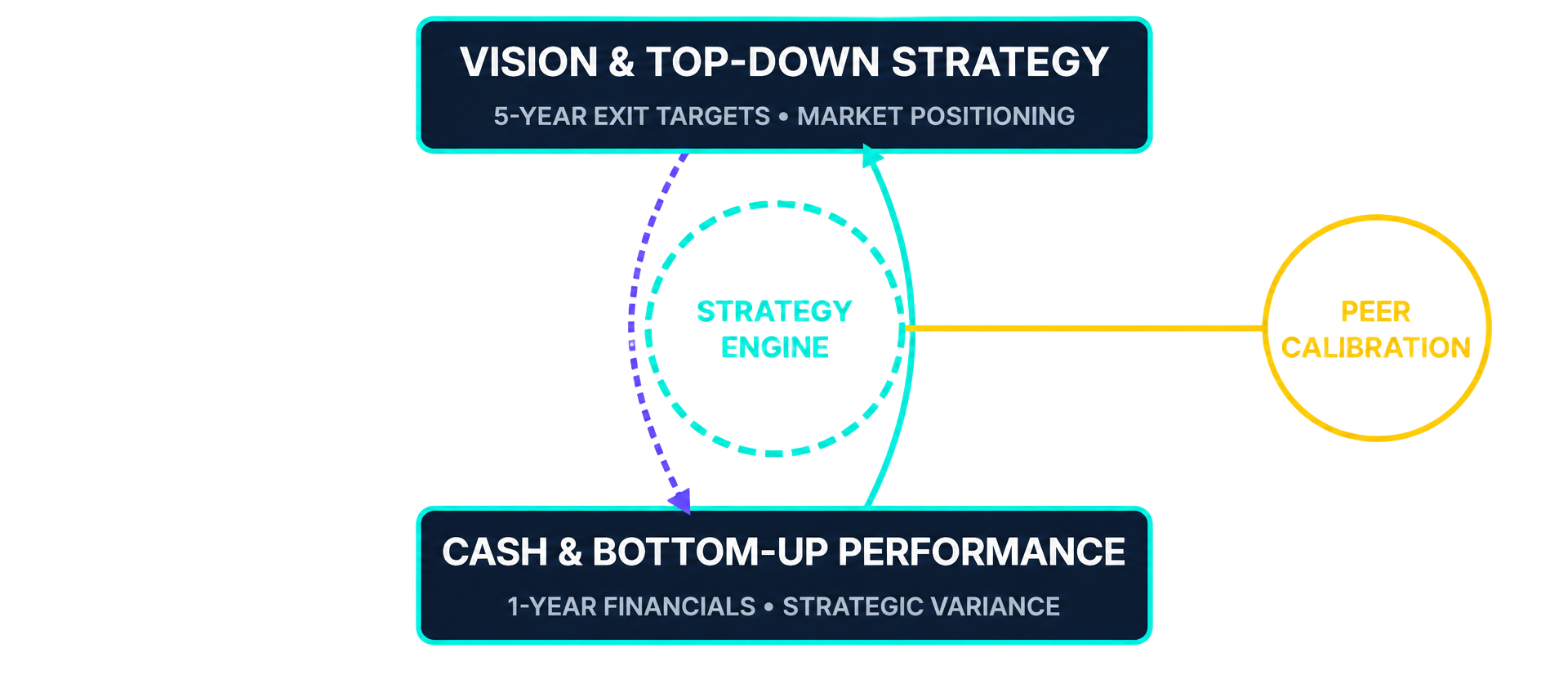
The horizon gap
| Metric | Traditional management (1-year) | Strategic integration (5-year) |
|---|---|---|
| Discipline | Budget vs. Actual (Compliance) | Strategy vs. Actual (Strategic Drift) |
| Horizon | Current fiscal year + forecast | Revolving five-year strategic model |
| Focus | Line-item P&L variances | Value driver and valuation-scenario implications |
| Data source | ERP / accounting data | Internal actuals, market evidence and management assumptions |
Strategic drift occurs when operating results, market conditions or strategic assumptions materially alter the probability of achieving the five-year plan.
Illustrative situation · Not a forecast
Imagine a business meeting its annual earnings target while customer concentration increases and planned investment slips. The monthly review would surface those changes, test their implications for the five-year plan, and help management decide whether to intervene.
The intended output is a clearer decision, revised assumptions and an accountable action—not a guaranteed valuation or exit outcome.
Planned capabilities include actuals integration, scenario modeling and benchmarking using public-company reporting. These are development goals, not available product features.
The monthly strategic review loop
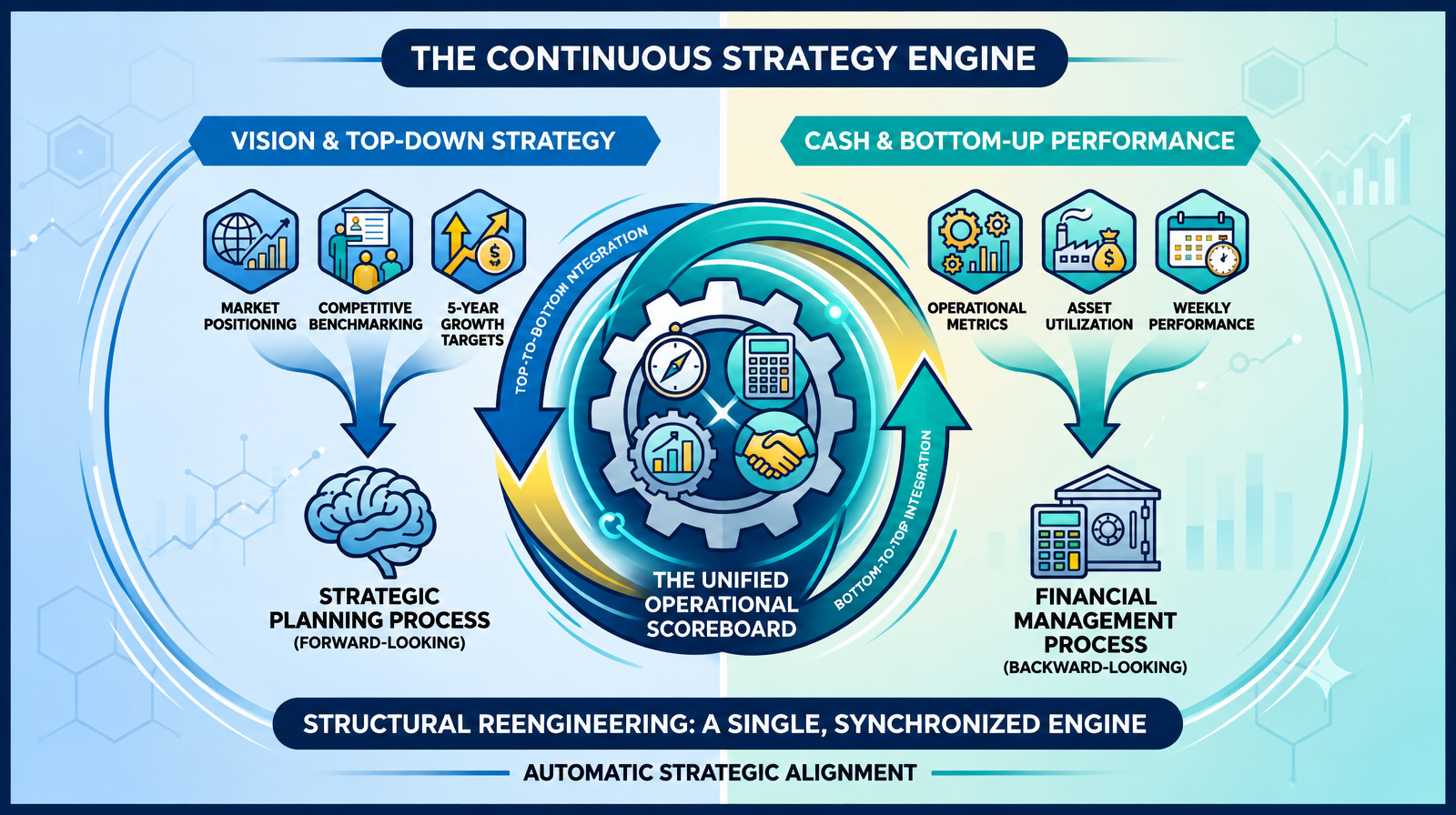
Value drivers, strategic milestones, assumptions, investment choices and valuation scenarios.
Financial actuals, operating indicators, market and peer evidence, and material competitor events.
Identify which assumptions or milestones are no longer tracking to plan and quantify scenario implications.
Is the deviation noise, a temporary variance, a correctable execution issue, or a strategic change?
Preserve course, intervene operationally, revise investment priorities, rebase assumptions, or explore a strategic option.
Record what changed, why, who decided, and what evidence will confirm or challenge the decision next month.
Validation & feedback
The Engine is in development. We welcome perspectives from owners and finance leaders on the problem and the proposed monthly review approach.